Can 2,200 satellites replace the internet?
A Starlink V3 fact-check
A viral post claimed 38 Starship launches could replace the internet. I built a model to check it. The claim is off by about ten times.
Watch it render live in your browser (8:31, English narration)
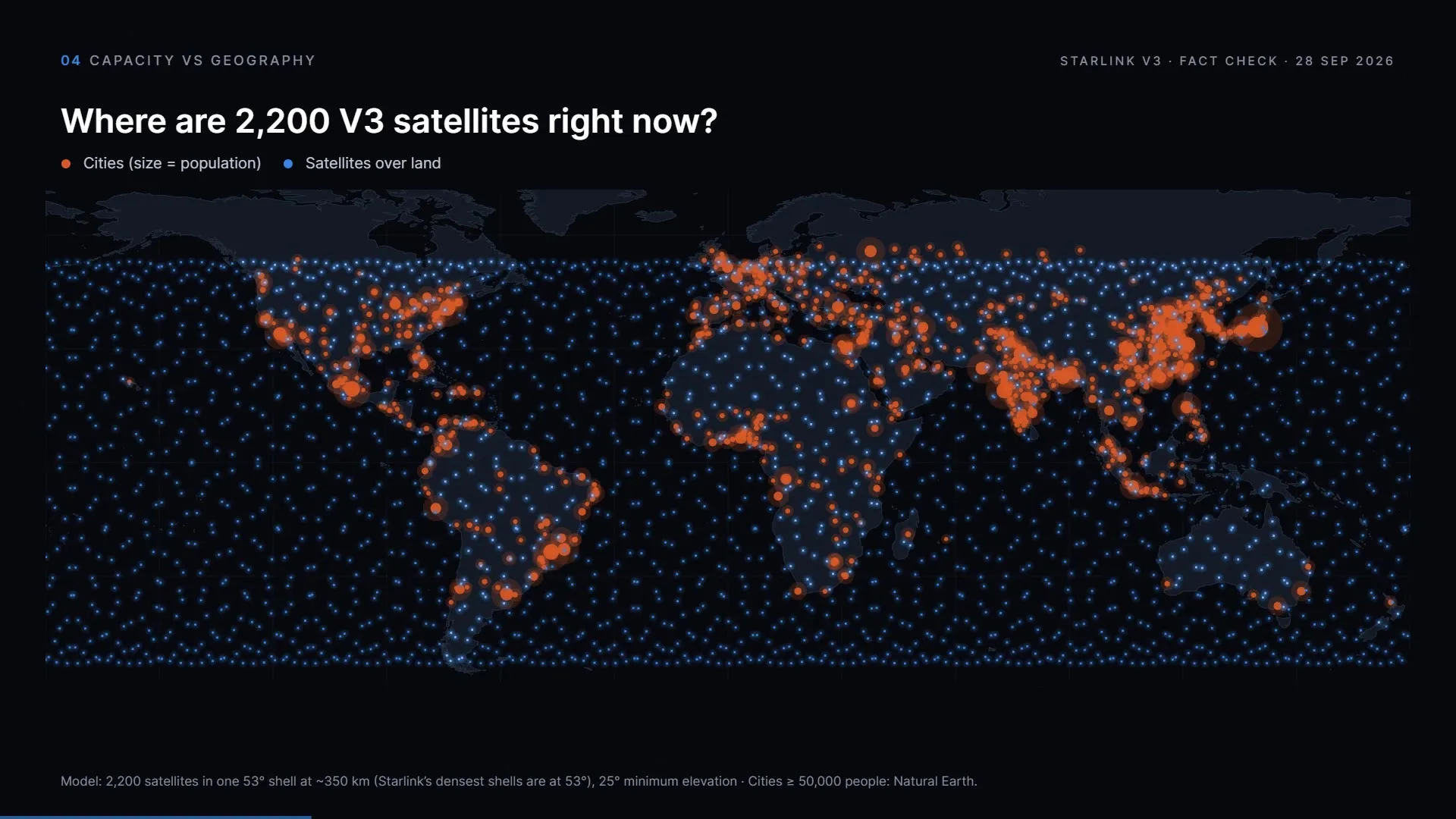
In September 2026 a post went around claiming that 2,200 next-generation Starlink satellites, launched on 38 Starships, could replace the internet. It sounded like back-of-the-envelope maths, so I did the envelope properly.
What the model does
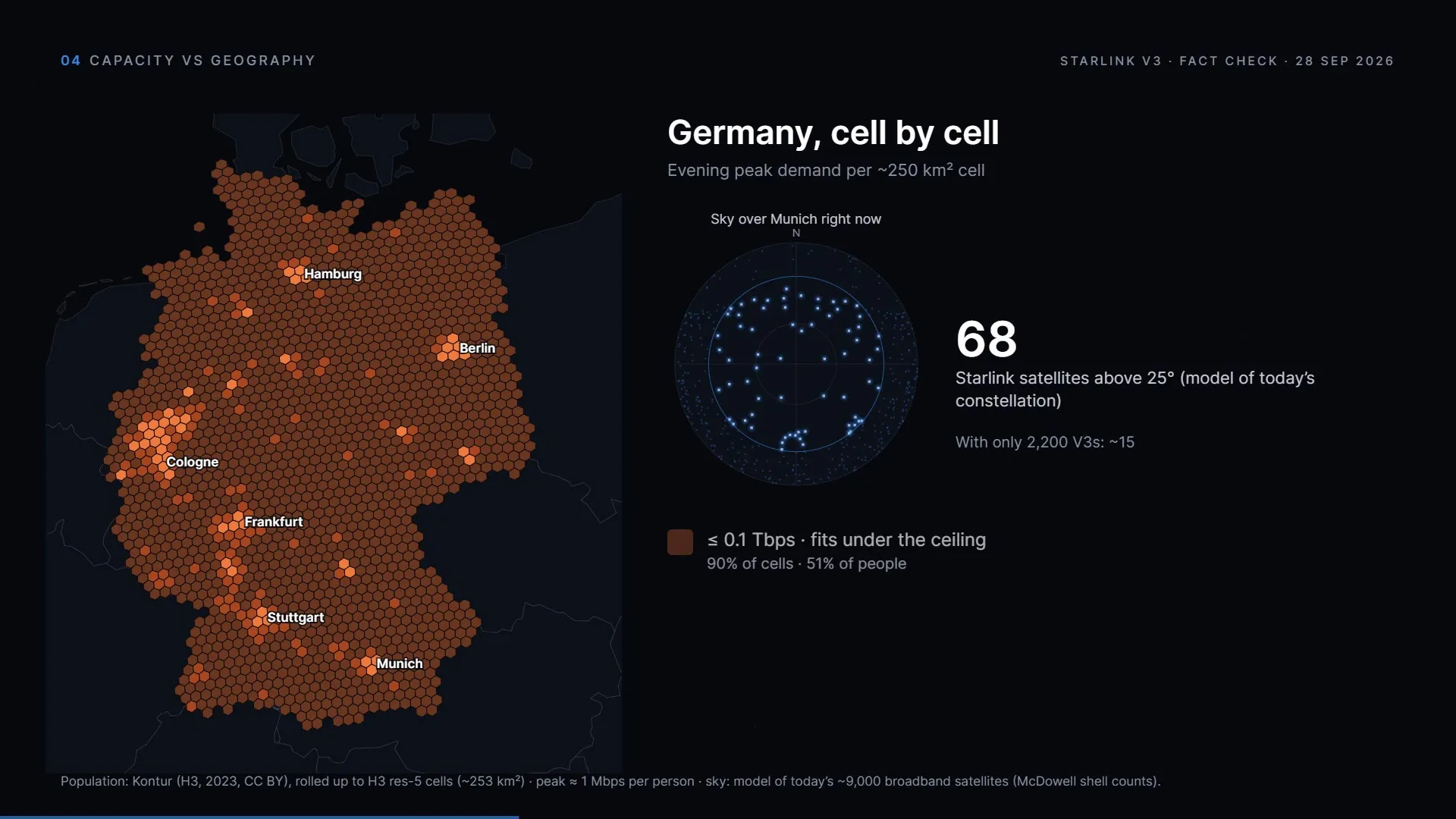
A hypothetical V3 constellation of 2,200 satellites in a 53° shell at about 350 km, routed against real population demand with a max-flow capacity model. Germany gets its own hex-grid demand map built from population data, plus latency floors from Munich to Frankfurt and a look at laser links across the Atlantic.
What came out
- 72 % of the satellites are over open ocean at any moment.
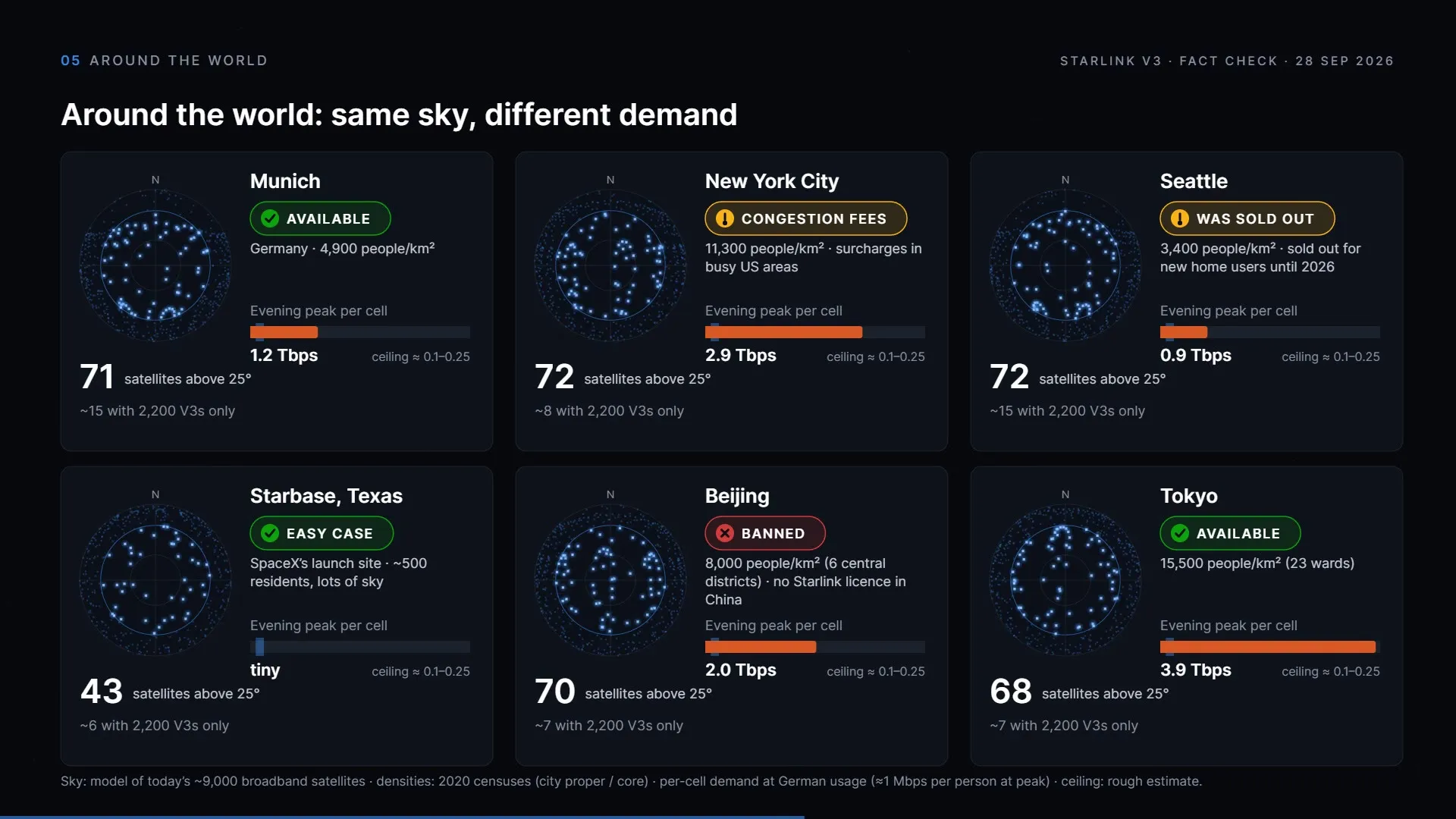
- They deliver about 700 Tbps to where people actually live. You’d need roughly 20,000 satellites.
- Only about five are over Germany at once.
- Tilting the orbits barely helps: delivered traffic goes from 33 % to 37 %.
- Munich to Frankfurt: about 6.5 ms over fibre, about 26 ms over Starlink today.
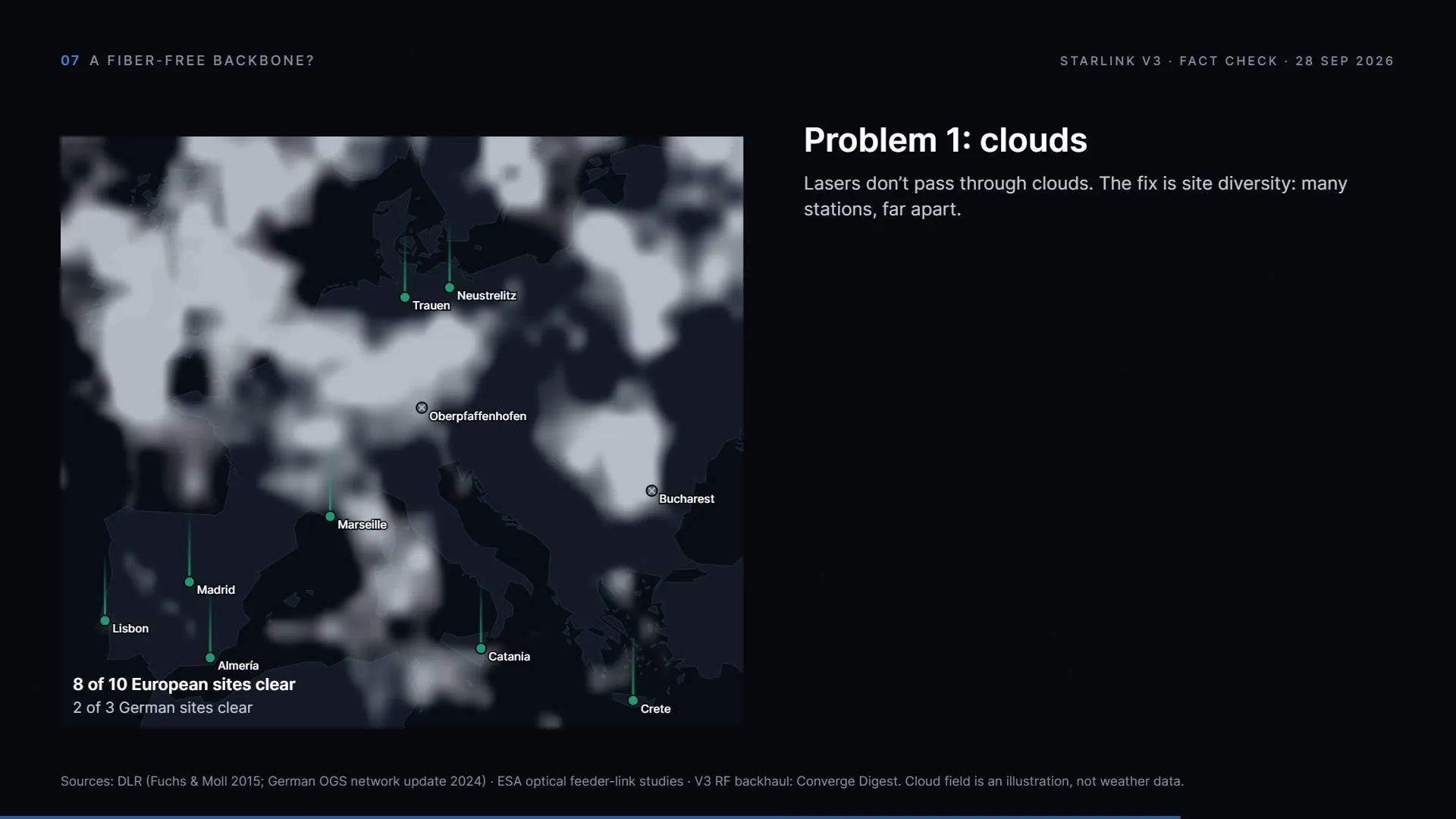
- Laser links win on latency beyond roughly 1,500 km, but not on capacity.
How the film is made
Every chart and map is drawn by a deterministic canvas renderer: give it a moment in time and it draws exactly that frame. Each scene stretches to fit its line of narration. There is no video file on this site: the button above runs the renderer in your browser, clocked by the narration. The heavy parts (the world map, Germany’s hex grid) are calculated once when the page loads, so each frame only has to put the layers together. The film ends on a full sources-and-method card.
A snapshot as of September 2026; the V3 constellation in the model is hypothetical.
Facts
- Stage
- Living: Live and still looked after. It can keep changing, and every change lands here.
- Category
- Data · Film
- Made with
- Python, H3 hex grids, Max-flow model, Canvas 2D, Node, ffmpeg, ElevenLabs
- Logged
- September 2026
- Last change
- 16 Nov 2026
What changed
Narration re-voiced in my own cloned voice, with a calmer opening; the film now runs 8:31, mixed to −20 LUFS.
The film now renders live in your browser, clocked by the narration, instead of playing a video file.
Every change across the site, and what preview, beta and living mean
Credits
- Coastlines, borders and places: Natural Earth (public domain).
- Population: Kontur Population (H3, 2023), CC BY 4.0.
- Starlink statistics: Jonathan McDowell, planet4589.org.
- Further sources listed in the film: TeleGeography, DE-CIX, Bundesnetzagentur, WonderNetwork, DLR, ESA, NASA, SpaceX progress reports and others.
- Narration: Jonas’s own voice, cloned with ElevenLabs (Eleven v4).
- The model is my own and simplified; capacity is optimistic.