The Things We Temper
A bell-founding game where physics decides
Cast a medieval bell in a GPU physics simulation. No script decides whether it rings or cracks; the bronze, the loam and the heat do.
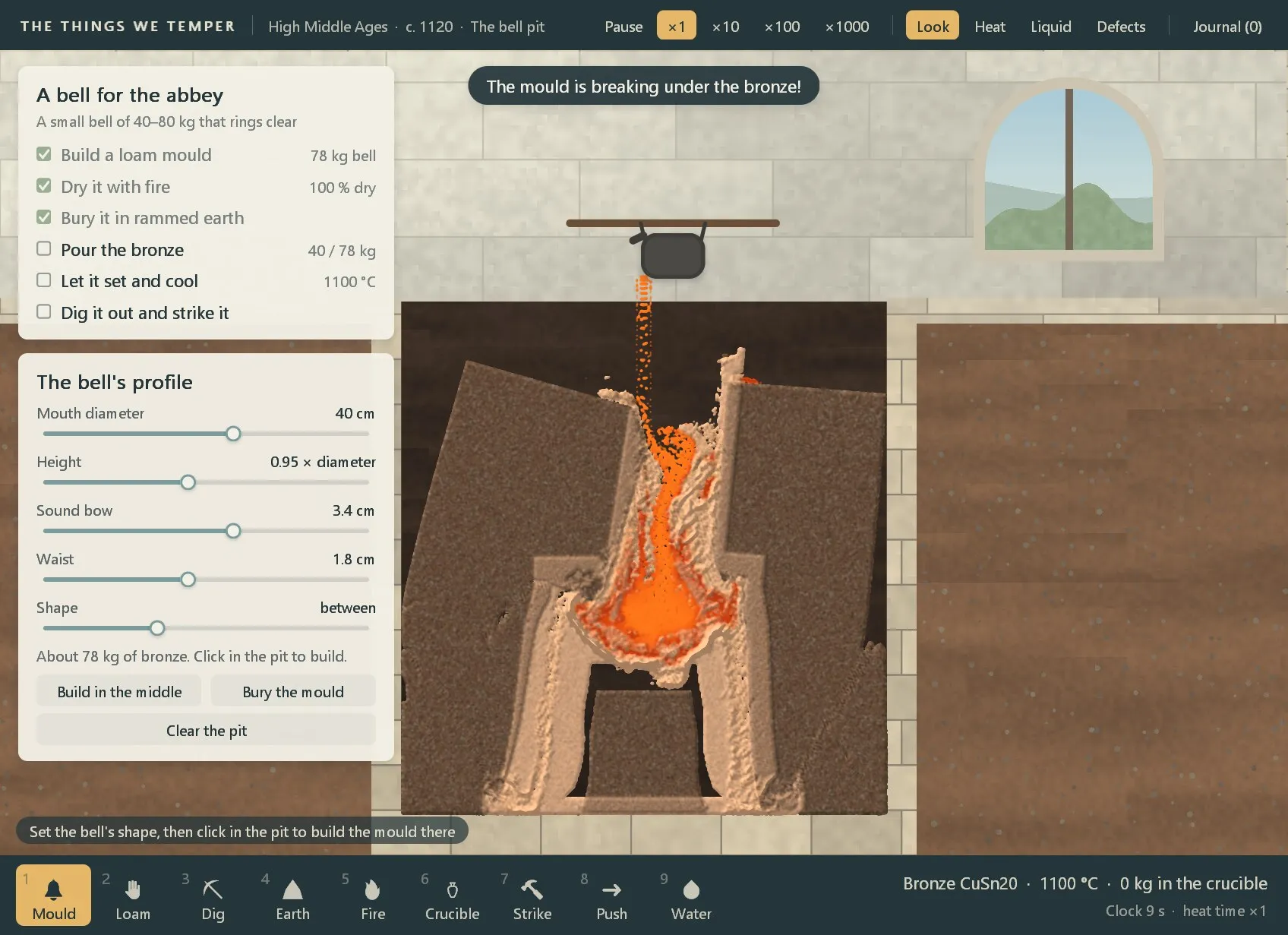
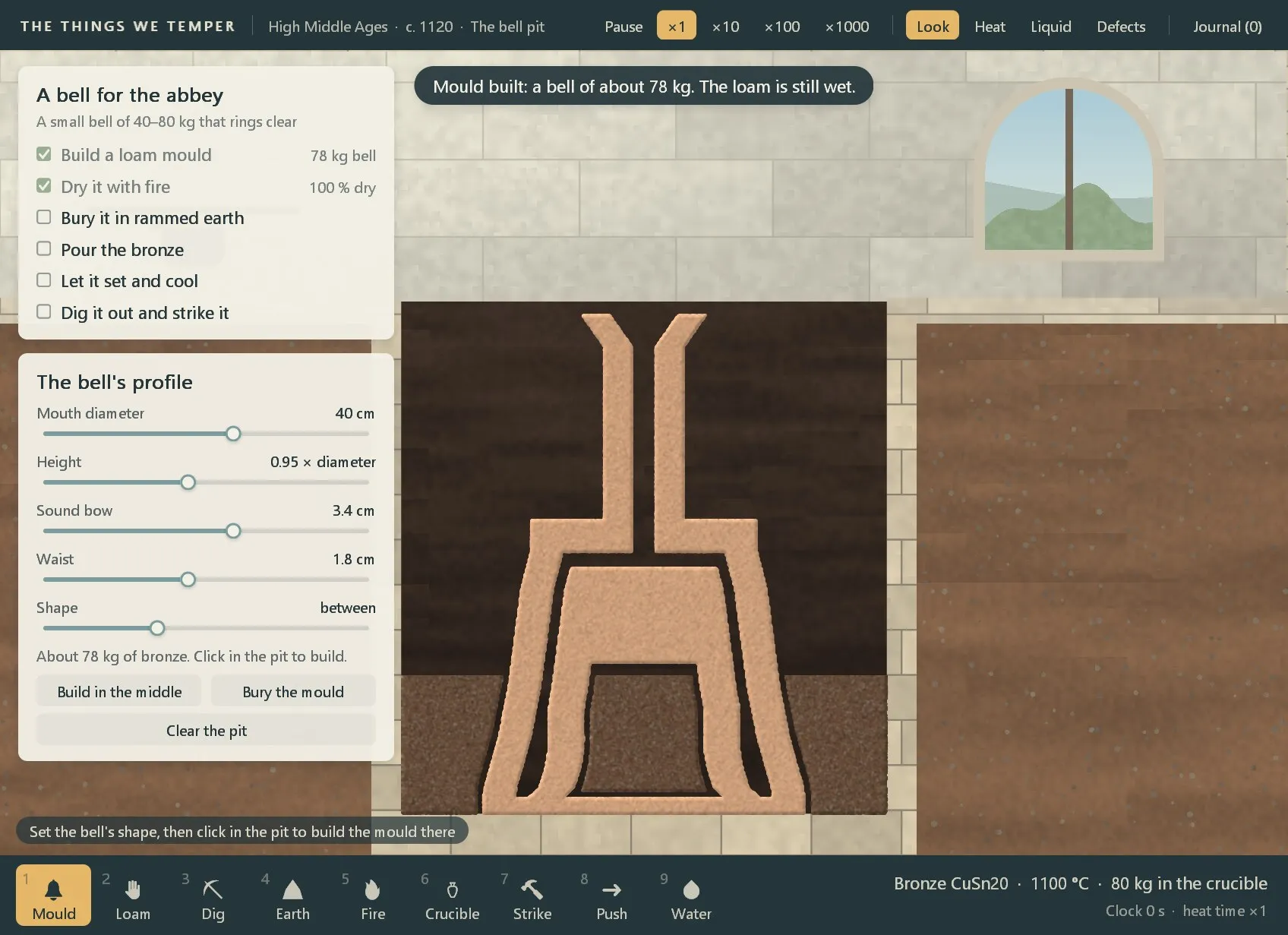
It’s around 1120 and the abbey needs a bell. You shape its profile, build a loam mould, dry it with fire (or don’t), bury it, choose the tin content and pouring temperature, pour, wait, dig it out and strike it.
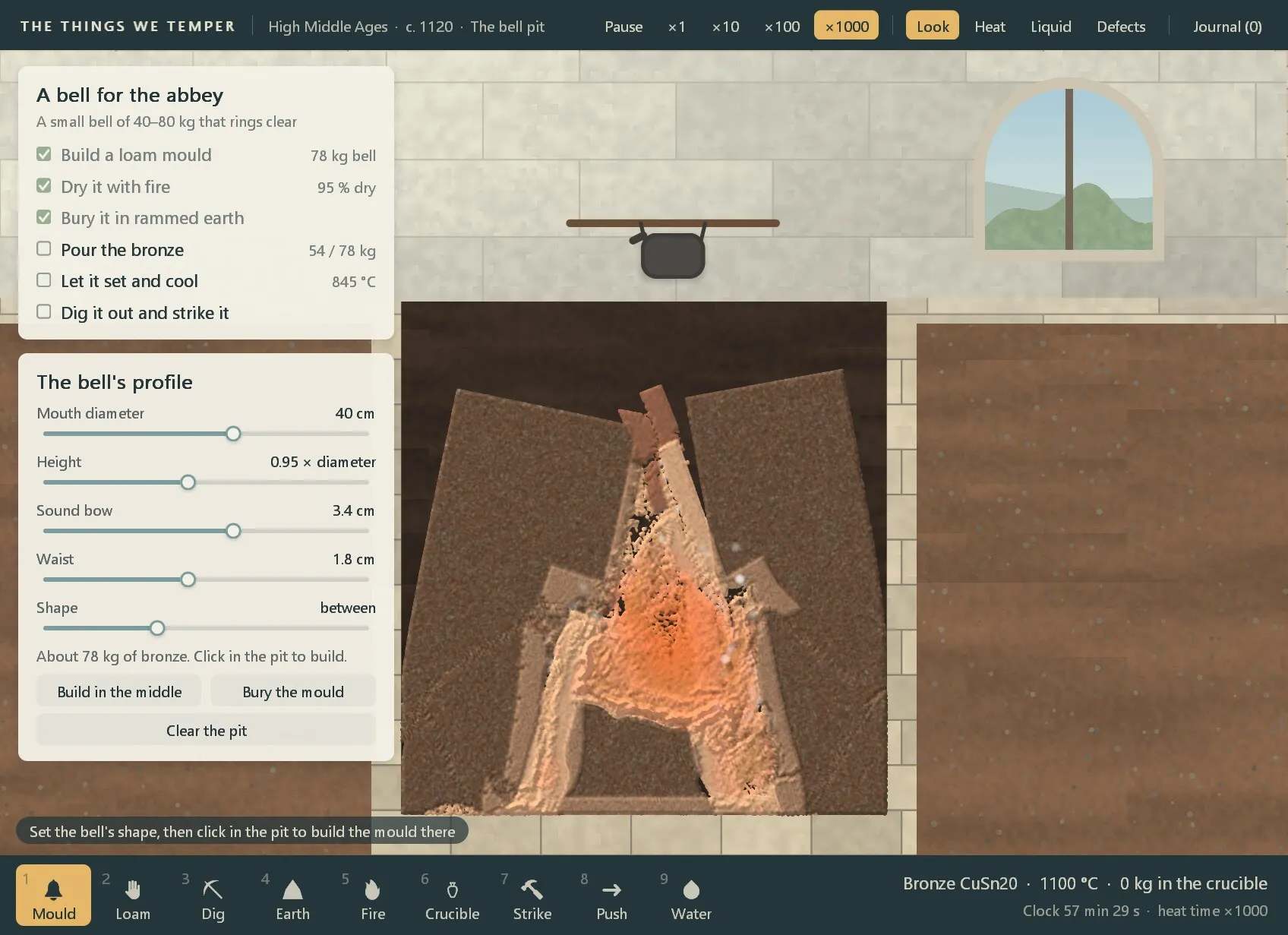
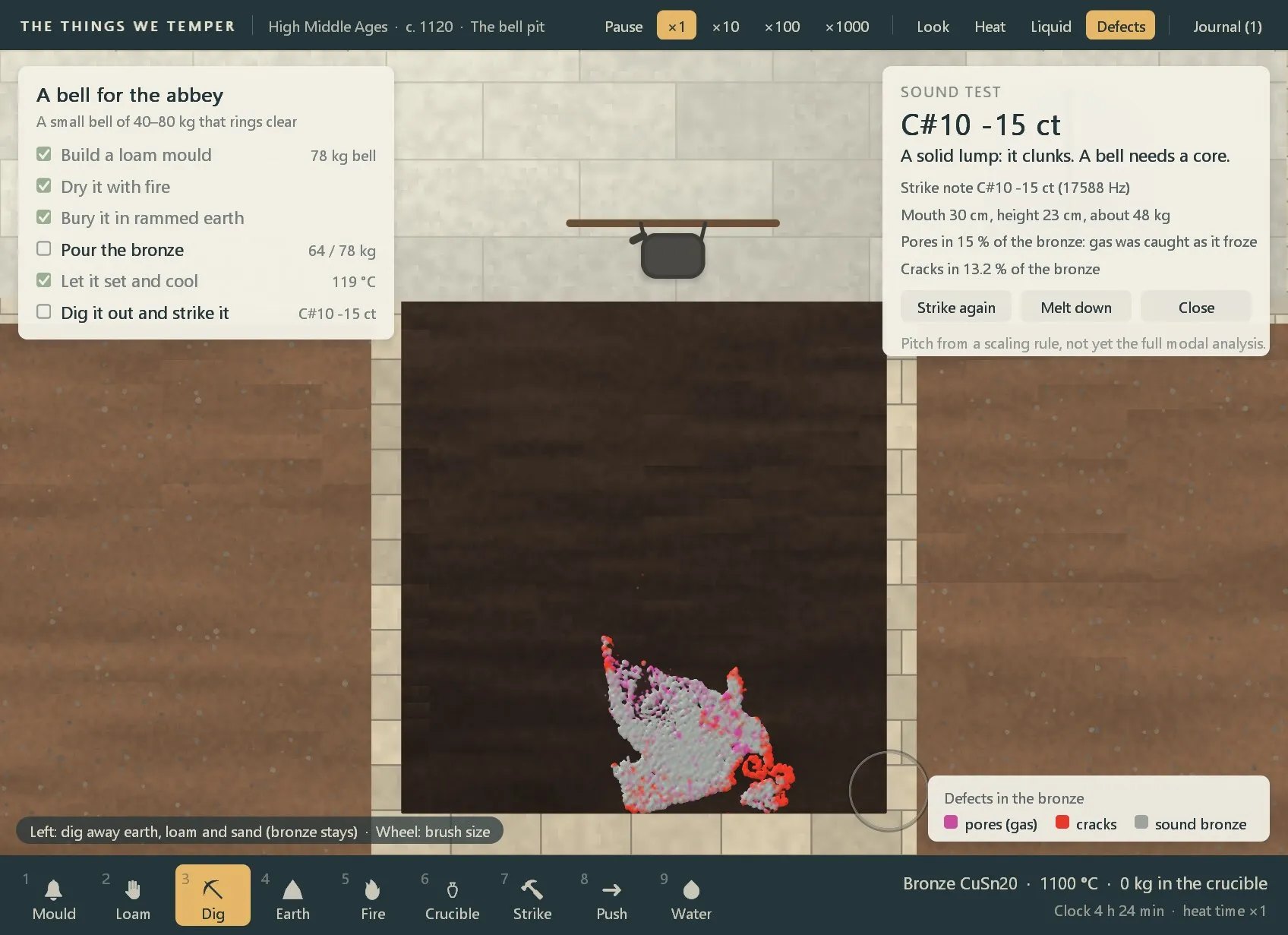
What makes it different: nothing is scripted. The bronze, sand and loam are a material point method simulation running on the GPU. Steam from a wet mould leaves pores. An unburied mould can burst under the weight of the metal. A bell can crack as it shrinks onto a stiff core. Then you hear what you made.
Under the hood
The game grew out of two engine experiments:
- MPM Foundry: a 2D sandbox written directly against Vulkan compute. Water boils and condenses, iron melts and pours into sand moulds, castings shrink and crack, sand melts to glass and glass shatters when quenched. 60,000 to 90,000 particles at 40 substeps a frame, in 9 to 15 ms.
- SI MPM: a slow reference version in real physical units, checked against theory: plate-impact stress within 3.3 %, yield onset within about 6 % for four metals.
The game itself runs a 512 × 320 grid at 3.9 mm per cell with up to half a million particles, and solves stiff solids with an implicit conjugate-gradient solver on the GPU.
Where it stands
First playable. Next up: a campaign of historical commissions, from a small abbey bell to the great bells of the 19th century.
Facts
- Status
- Underway
- Category
- Game · Physics
- Made with
- C++20, Vulkan 1.3 compute, GLSL, Material Point Method, CMake
- Logged
- November 2026
Credits
- Method after Theophilus, De diversis artibus (12th century).
- Pitch scaling calibrated on bell measurements by Perrin, Charnley & DePont (1983).
- Material values from handbook data.